

- /
Retiring in Las Cruces, NM: The Honest Guide to Healthcare, Daily Life & Lifestyle
TL;DR — The Quick Answer
If you want the full picture, watch the video or keep reading. But if you need the short version right now:
∙ Las Cruces is a quiet, affordable small city with minimal traffic and mild winters
∙ You need a car — it is not a walkable city, though limited transit options exist
∙ Two solid local hospitals cover everyday healthcare needs; El Paso (45 min away) handles major trauma and specialized care
∙ The lifestyle is genuinely active — pickleball, golf, hiking, gyms, and a university in your backyard
∙ It is not for everyone — people either love the pace or miss the energy of a bigger city
Bottom line: For the right retiree, Las Cruces is an exhale. For the wrong one, it can feel too small. Know which one you are before you move.
https://bit.ly/4dqf0Dz
Is Las Cruces a Good Place to Retire?
Let me give you the honest answer right upfront — yes, Las Cruces is a solid retirement destination. But it depends entirely on what you’re looking for.
I’m Elaine. I’ve been a real estate agent here for 8 years, I was born and raised in Las Cruces, and I’ve also lived in California and Florida. When I tell you what the traffic is like or what the pace of life feels like here, I have real comparison points. I’m not just telling you what you want to hear.
Las Cruces is a small city that lives like a small town. For a lot of people retiring from big cities, that is the point. They want slower. They want quiet. They want to stop white-knuckling it through daily life. That is genuinely what this city offers.
Daily Logistics: What Life Actually Looks Like
Traffic and Getting Around Town
Our biggest infrastructure drawback is that the roads weren’t designed for the population we now have. We do have rush hour — kids getting out of school at 2 and 4 will slow things down, and Fridays around noon tend to be heavier.
But here’s some real perspective: I have lived in California and Florida. I know what traffic actually is. In Las Cruces, worst case, you’re looking at 20 to maybe 30 or 40 minutes to get across the city depending on where you’re going and the time of day. That is it. You are not sitting on a freeway for an hour going nowhere. We have a lot of retirees here, and people just tend to drive a little slower. Road rage culture? We really don’t have it.
Walkability and Transportation
Las Cruces is not a walkable city. If you live downtown, you have restaurants, the farmers market, coffee shops, and local shops within reach. But for most of the city, you need a car. If you’re planning to retire here without a vehicle, that plan needs a serious rethink.
That said, public transit options do exist. RoadRUNNER Transit operates 8 fixed bus routes connecting major shopping areas and medical centers throughout the city. For seniors 60 and older and those with disabilities, the city offers Vamonos — a paratransit program providing wheelchair-accessible, curb-to-curb shared rides you can book in advance. It’s not New York, but if you plan ahead, it can work. Vamonos in particular is worth knowing about if driving becomes a concern down the road.
Shopping and Groceries
You have multiple Walmarts, Target, Sprouts, Smith’s, and Albertsons. Most areas of the city put you within 5 to 10 minutes of a grocery store. The east side and Sonoma Ranch area are especially well-positioned — most errands are quick and easy.
The Weather — Honest Version
Our winters are genuinely mild — sunny days in the high 50s to low 60s for most of the season. For anyone coming from a place with brutal cold or heavy snowfall, this is a real quality-of-life upgrade.
Our summers are hot. I’m not going to pretend otherwise. July and August hit triple digits, and the heat hangs around into October. Plan for that.
What we don’t have: tornadoes, ice storms, hurricanes. Maybe every other year we get some hail. Our monsoon season can bring heavy rainfall, and flooding does occur — but it’s mostly concentrated closer to downtown. The Sonoma Ranch area and further outskirts are largely unaffected.
Buyer tip: Always check flood maps before committing to a home. Flood insurance can add $100 or more per month to your costs — and that money is better spent on more house.
Healthcare in Las Cruces: What’s Here, What’s Not
This is the section I know a lot of you came here for, and I want to give it to you straight — because healthcare is the number one concern I hear from retirees considering this area.
What We Have Locally
Las Cruces has two main hospitals — MountainView Regional Medical Center and Memorial Medical Center. Both are full-service facilities offering emergency care, surgeries, routine procedures, and a range of specialists. For the everyday healthcare needs of most retirees — primary care, cardiology basics, orthopedics, general surgery — you are covered locally. The network of clinics and outpatient facilities throughout the city has grown significantly and continues to expand.
Where the Gaps Are
There are gaps, and I want to be upfront about them. If you have a serious cardiac event, a complex cancer diagnosis, or a trauma situation requiring a Level 1 trauma center — Las Cruces does not have that. For major trauma and highly specialized care, you’re looking at El Paso, about 45 minutes south on I-10. Certain subspecialties — advanced neurology, specific oncology, some cardiac interventions — may also require referrals to El Paso. That is simply the reality of a smaller city.
Is 45 Minutes to El Paso a Problem?
For most people, no. El Paso has University Medical Center and Del Sol Medical Center — both large, well-equipped facilities. Having that level of care less than an hour away is genuinely not a bad situation. But if you have a serious ongoing condition requiring frequent specialist visits, go in with eyes open and confirm your specific care is accessible before you commit to the move.
My honest take: For a healthy retiree or someone managing typical age-related conditions, the healthcare here is more than adequate. You will find good doctors. You will be taken care of. But complex medical needs require homework before you move.
Lifestyle and Amenities: What Las Cruces Actually Offers
This is honestly one of Las Cruces’s best-kept secrets — and something people don’t fully appreciate until they’re here.
Pickleball
Yes, we have it — and it’s growing fast. Courts are available at several parks throughout the city, and the community is active. I know of at least three locations across different parts of the city. My personal favorite: the courts at the Rio Grande Winery. Pickleball and wine — that’s a retirement activity I can get behind.
Golf
Four golf courses in the area, and the weather means you can play nearly year-round. Green fees are very reasonable compared to California or the Pacific Northwest. I live close to the Sonoma Ranch course — mostly I’m there for the clubhouse, which has great food and drinks. The Red Hawk course near the Metro Verde community is getting a brand new clubhouse, and it is a stunning course — a genuine green oasis in the middle of the desert.
Hiking
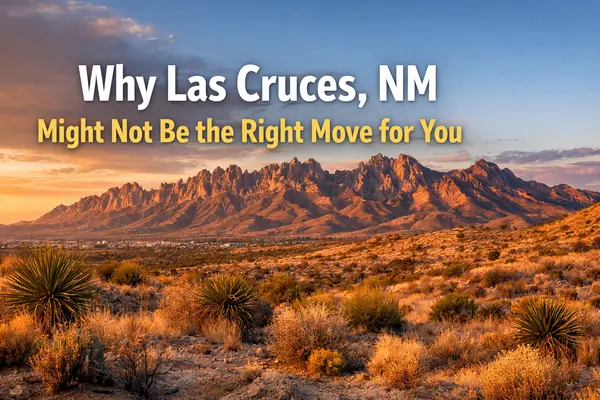
The Organ Mountains-Desert Peaks National Monument is right in our backyard. Trails range from easy walks to serious elevation hikes, and the scenery is genuinely stunning. If you’re an outdoor person, this is a major quality-of-life win.
Gyms and Fitness
We have Planet Fitness, 310 Fitness in the Sonoma area (fully equipped with a pool, sauna, indoor basketball courts, and pickleball courts), and Bionic — a newer gym closer to the center of the city. Staying active here is easy and affordable.
Senior Centers and 55+ Communities
Las Cruces has senior centers offering programs, classes, social activities, and fitness options specifically for the 55+ crowd. There are also dedicated 55+ residential communities if that environment appeals to you — neighbors in a similar life stage, amenities geared toward that demographic, and a built-in social scene.
NMSU
New Mexico State University is right here, and it matters more than people realize. Cultural events, lectures, sports, continuing education — it keeps the city intellectually alive in a way you don’t always get in a small town.
Your Questions Answered
Q: How does Las Cruces healthcare compare to what I had back in California?
It depends on what you’re used to and what you need. In a major California metro, you likely had a wide network of specialists and multiple Level 1 trauma centers within a short drive. Las Cruces has two solid full-service hospitals and a growing outpatient network — more than enough for everyday healthcare and most routine needs. Where you’ll notice a difference is in subspecialty access. If you relied on a specific oncologist, neurologist, or cardiac specialist, verify whether their equivalent is available locally or whether El Paso has what you need. For most healthy retirees managing typical age-related conditions, the transition is smooth. For those with complex ongoing needs, it requires more planning.
Q: Is Las Cruces actually safe for retirees?
Like any city, Las Cruces has areas that are safer than others. The east side, the Sonoma Ranch corridor, and newer developments tend to be where retirees feel most comfortable. Crime exists — I won’t pretend otherwise — but it’s heavily concentrated in specific pockets. The day-to-day reality for most retirees in well-established neighborhoods is a quiet, low-concern environment. People leave their garage doors open. Neighbors know each other. Do your homework on neighborhood selection before you buy, and safety is not a significant concern for the typical retiree lifestyle here.
Q: What does it actually cost to retire in Las Cruces compared to where I live now?
If you’re coming from California or the Pacific Northwest, Las Cruces is going to feel dramatically more affordable. Property taxes in New Mexico are among the lowest in the country. Utilities are manageable. Groceries, dining, and services all run lower than what most transplants are used to. Housing is the biggest number — solid homes in good neighborhoods range from the low $200,000s to the mid $400,000s depending on size and location. If you’re selling a California home, there’s a very good chance you’re arriving with equity that makes this transition financially comfortable. New Mexico also has favorable tax treatment for retirees on Social Security and pension income — worth talking to a local accountant about before you move.
Q: What happens if I stop being able to drive — is there real support for that in Las Cruces?
Plan for it now rather than after the fact. Las Cruces has RoadRUNNER Transit with 8 fixed bus routes, and more importantly, the Vamonos paratransit program for seniors 60+ and those with disabilities — wheelchair-accessible, curb-to-curb rides you book in advance. That said, your housing location matters a lot here. My advice: factor proximity to medical offices, grocery stores, and services into your home search from day one — not as an afterthought.
Q: Is Las Cruces too small and boring for retirement, or is there actually enough to do?
This is the question that separates people who thrive here from people who don’t. Las Cruces is not a city that stimulates you with endless options and nightlife. If that’s what you need, this isn’t your city. But for retirees who want an active, outdoor-oriented lifestyle — pickleball, golf, hiking, good gyms, a university, a farmers market, a restaurant scene that keeps improving — there is genuinely a lot here. The retirees I’ve watched thrive are the ones who come in with a hobby, a reason to be active, and a genuine desire to slow down. The ones who struggle are usually expecting a city that Las Cruces simply is not.
Thinking About Making the Move?
Do your research. Read the comments on the video — people are candid about their experiences, and that real-world feedback is valuable.
If you’re seriously considering retiring here, reach out to me directly. I’ve been doing this for 8 years and living here for over 30. I was born and raised in Las Cruces, I’ve lived elsewhere, and I came back. I’ll give you the real answer — not the sales pitch.
📧 Contact me at @ Happylife.elaine@gmail.com
Recent Posts





"My job is to find and attract mastery-based agents to the office, protect the culture, and make sure everyone is happy! "